Mastering Marine automation & Industrial Automation Careers
Section 1: Understanding the Core Fields
Q1: What is the difference between Industrial Automation and Marine Automation?
While both fields share foundational concepts of control systems, PLCs, and instrumentation, their application environments differ entirely:
Industrial Automation: Focuses on land-based manufacturing plants, automobile industries, petrochemical refineries, and power generation units. It utilizes Programmable Logic Controllers (PLCs), SCADA (Supervisory Control and Data Acquisition), Distributed Control Systems (DCS), and relay logic panels to maximize production efficiency and safety.
Marine Automation: Focuses on the complex operational systems aboard commercial cargo vessels, oil tankers, offshore drilling rigs, and cruise ships. It monitors and controls shipboard machinery, engine room parameters, auxiliary systems, navigation equipment, and fluid power networks.
Q2: Why are automation skills in such high demand globally?
Modern industries are transitioning toward Smart Manufacturing and Industry 4.0. In the maritime sector, the rise of Autonomous Ships (MASS – Maritime Autonomous Surface Ships), real-time sensor networks, and smart engine rooms require certified technicians who understand precise instrumentation, calibration, and troubleshooting. Companies prefer industry-ready professionals who can minimize equipment downtime and manage advanced control systems right from day one.
Section 2: Educational Pathways & Training Queries
Q3: I have a Diploma or B.Tech in Electrical/Electronics/Mechanical Engineering. Do I need specialized training?
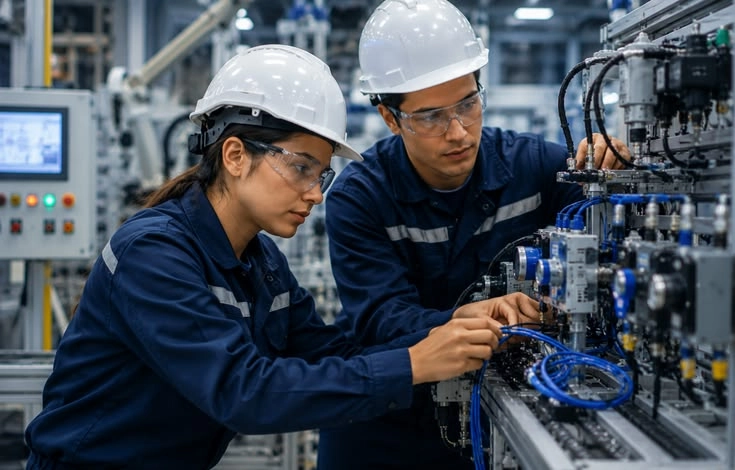
Academic curriculums provide essential theoretical foundations, but they rarely expose students to live industrial equipment, high-pressure hydraulic loops, or marine-grade electrical termination standards. Specialized short-term training programs bridge this gap by providing intensive, hands-on lab sessions on simulators and real-world industrial hardware.
Q4: What key practical skills should a student master during training?
To stand out to international employers and placement officers, students should focus on acquiring proficiency in:
Cable Glanding, Crimping & Termination: Executing neat panel wiring and secure cable management following marine safety standards.
Loop Checking (Hot & Cold): Verifying circuit continuity, signal transmission, and sensor accuracy from field instruments to control rooms.
Instrumentation Calibration: Accurately measuring and calibrating pressure, temperature, level, and flow transmitters.
Hydraulic and Pneumatic Systems: Understanding fluid power circuits, valve actuators, and compressed air management used in heavy machinery and ship steering gear.
Section 3: Career Scope, Placements, and Industry Expectations
Q5: What job roles can I expect after completing a specialized automation or marine electrical program?
Depending on your certification and area of specialization, graduates frequently step into roles such as:
Marine Electrician / Electro-Technical Officer (ETO) Track: Managing shipboard power distribution, electrical maintenance, and automation systems.
Instrumentation Technician: Installing, maintaining, and repairing measurement and control instruments in oil & gas plants.
Automation Engineer / PLC Programmer: Designing, testing, and troubleshooting automated industrial control systems.
Hydraulics & Pneumatics Specialist: Maintaining fluid-powered mechanical control systems across factories and offshore vessels.
Q6: Is 100% placement assistance a realistic expectation?
Reputed training institutions that maintain strong industry partnerships, active recruiter networks, and dedicated placement cells can offer structured guidance, interview preparation, and direct employer interviews. However, a student’s success ultimately depends on their active participation in practical lab sessions, technical aptitude, and problem-solving mindset.
Section 4: Tips for Students Preparing for Interviews
Focus on Fundamentals: Brush up on basic electrical laws, control loop principles, relay logic, and sensor operation. Interviewers value strong fundamentals over memorized theory.
Highlight Hands-On Experience: During technical interviews, emphasize the practical hours you spent working directly with physical panels, multimeters, calibrators, and simulators.
Stay Updated with Industry Trends: Familiarize yourself with emerging technologies such as predictive maintenance, IoT-enabled sensor networks, and eco-friendly vessel automation systems.
Final Thoughts: Building a Successful Career in Automation
The industrial and maritime sectors are evolving faster than ever. As automation technology continues to reshape global trade, smart manufacturing, and vessel operations, the demand for highly skilled, hands-on trained engineering professionals will only continue to surge.
While academic degrees build your foundation, practical expertise, real-world panel wiring, and instrument calibration are what truly elevate your job prospects. Acquiring targeted skill sets in PLC programming, hydraulic systems, and marine electrical termination turns your theoretical background into an industry-ready profile.
At Voyage Institute of Technology, we bridge the gap between classroom education and real-world industrial demands. Equipped with state-of-the-art automation labs, simulated training environments, and experienced industry mentors, our career-oriented programs empower B.Tech, Diploma, and ITI graduates to step directly into high-demand engineering roles globally. With comprehensive, hands-on training and dedicated placement assistance, Voyage Institute of Technology ensures you are fully prepared to take charge of your future in Marine and Industrial Automation.
Latest Post
-
Mastering Marine Automation & Industrial Automation Careers
-
Top Industrial & Marine Automation Courses in Kerala: Scope, Curriculum, and Career Guide
-
 Is Industrial Automation a Good Career Choice in 2026?
-
 Best Courses After ITI & Diploma – Career-Oriented Automation Courses
-
 Best Course After B.Tech In Kerala : Top Career-Oriented Courses for Engineering Graduates
We are a group of Experienced passionate professionals spent many years working in the marine, oil and gas, petrochemical, and energy sectors.
Other Pages
Quick Links
Copyright © 2023 Voyage Institute Of Technology Pvt Ltd, All rights reserved.